


Communities Do Not Start with Money “The Number One Problem Is Staff”
6/13/20264 min read
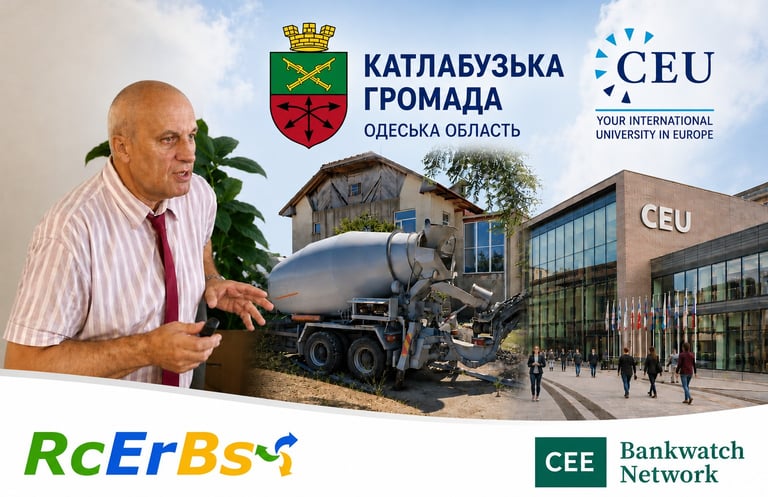
From a Business Incubator to Energy Security
— We usually call our organization the Foundation - that is simply how it has been known for 20 years. The NGO was founded in Lubny as a scientific and economic structure supporting small and medium-sized businesses. In the early 2000s, we worked practically as a business incubator. After 2014, the Lubny municipality invited us to join the city’s sustainable development efforts.
Ruslan Shcherbakov explains that this was when the team began working systematically on energy efficiency and energy security issues.
— When everyone was talking about energy efficiency, we were already talking about energy security. We even developed a local energy security plan for Lubny - in parallel with the local energy plan. Unfortunately, it still remains virtually the only document of its kind in Ukraine.
In 2017, 24 communities and scientific organizations joined the memorandum of cooperation. Today, there are already more than 180 participants.
Over this period, the Foundation implemented a number of projects together with NEFCO: modernization of municipal lighting, upgrading of water supply systems, automation of processes, as well as the installation of solar power plants and the modernization of a medical complex in Lubny.
The Katlabuzka Community and the Problem of the “Closed Circle”
The Katlabuzka community joined the Sambria project after the beginning of the full-scale war.
— The project was created almost immediately after 2022, when Spain joined the effort to support Ukraine. We began working on municipal energy plans, environmental security strategies and climate change adaptation. Over three years, we prepared around 70 such documents.
Ruslan Shcherbakov describes the community’s energy situation as typical for the rural South of Ukraine: dependence on centralized electricity supply, the absence of local generation and weak backup infrastructure.
— They are located near Izmail, where there are constant strikes and infrastructure restoration works. You understand how it works.
The community plans to install solar power plants on social facilities, but the main problem is not the idea itself - it is the transition to implementation.
“To attract financing, a feasibility study is needed. And for a feasibility study, financing is again required. A closed circle.”
According to Shcherbakov, this is exactly why the Project Navigator is being created - a platform designed to help communities build a project portfolio, prepare applications, work with feasibility studies, monitor donor programs, and engage experts and businesses.
Energy Communities: “Community - Authorities - Business”
A separate part of the conversation focused on energy communities.
The expert is convinced that in Ukraine this topic is often understood too narrowly.
— If waste clusters can exist, why can’t energy communities exist? We greatly underestimate small and medium-sized businesses, which need to be involved.
He describes a triangle model: community, authorities and business.
In his view, this model is capable of forming energy clusters and local development alliances.
— Business can be a provider of solutions. Authorities can help with funds, land or regulatory decisions. And civil society can initiate change.
“The Number One Problem Is Staff”
During the interview, Shcherbakov repeatedly returns to the main problem facing Ukrainian communities.
“The number one problem is staff. Not finances.”
According to him, even strong project ideas often stall because of a lack of people who are able to coordinate the process, work with documents, prepare applications and, most importantly, search for solutions.
— If a community has two or three people who are genuinely driving development, that is already a lot. The Katlabuzka community has such a team. And that is already a plus.
At the same time, in his view, many communities underestimate their own capabilities.
— Financing comes only at the end of these 12 steps. When a community goes through the path from a political decision to analytics, it often turns out that some solutions can be implemented using its own resources.
Why Energy Monitoring Is More Important Than New Generation
Shcherbakov names energy monitoring as one of the key areas of work.
— A plan is a strategy. But a strategy has to be implemented. And the starting point must be understanding exactly what the community consumes and where it loses resources.
He recalls the experience of Lubny, where, after the installation of an automated energy monitoring system, the city budget saved around 14% of energy resources in one year.
The causes of losses were very simple.
— At the stadium, taxi drivers were washing their cars with municipal water. In kindergartens, taps were not turned off over the weekend. The city had around 300 pipe bursts per year. Water losses reached 60%.
After analyzing the data, the city began implementing small but effective solutions:
individual heat substations;
consumption control;
ESCO mechanisms;
automation of metering.
— The priority is the cheapest option - and even better, a free one.
Civil Society as a Resource
Another important topic of the conversation is the role of civil society in community development.
Shcherbakov speaks about this quite directly.
“Community heads are very afraid of civil society. But in reality, civil society is their tool.”
He recalls the experience of the public council in Lubny, through which difficult decisions passed before being submitted to a city council session.
— When everyone gathered in one room - deputies, police, doctors and civil society - many conflicts were resolved before the official vote.
In his opinion, NGOs today remain an underestimated resource for communities: they can be grant recipients, coordinate projects, engage experts and work directly with donors.
Today, the Foundation works not only with energy plans, but also with local waste management plans and climate adaptation, eco-industrial solutions and international Interreg projects.
But the main idea of the interview remains unchanged:
“Communities greatly underestimate their own capabilities.”
And perhaps this is precisely the main challenge for the development of Ukrainian communities today - not only during the war, but also after it.
Interview with the President of the Regional Center for Economic Research and Business Support
Ruslan Shcherbakov was recorded as part of a master’s research project
Central European University, represented by Anna Rudzinska.
The research is devoted to the topic:
“Renewable energy and community energy resilience amid wartime disruptions in energy supply: the case of the Katlabuzka community (Odesa oblast, Ukraine).”
At the center of the research is the question of how Ukrainian communities can strengthen their own energy resilience through the development of local generation, energy management and new models of cooperation under wartime conditions.
The conversation went far beyond the topic of energy. It is about the capacity of communities, the shortage of qualified personnel, the role of business and civil society, and why development often begins not with money, but with people and systematic thinking.