
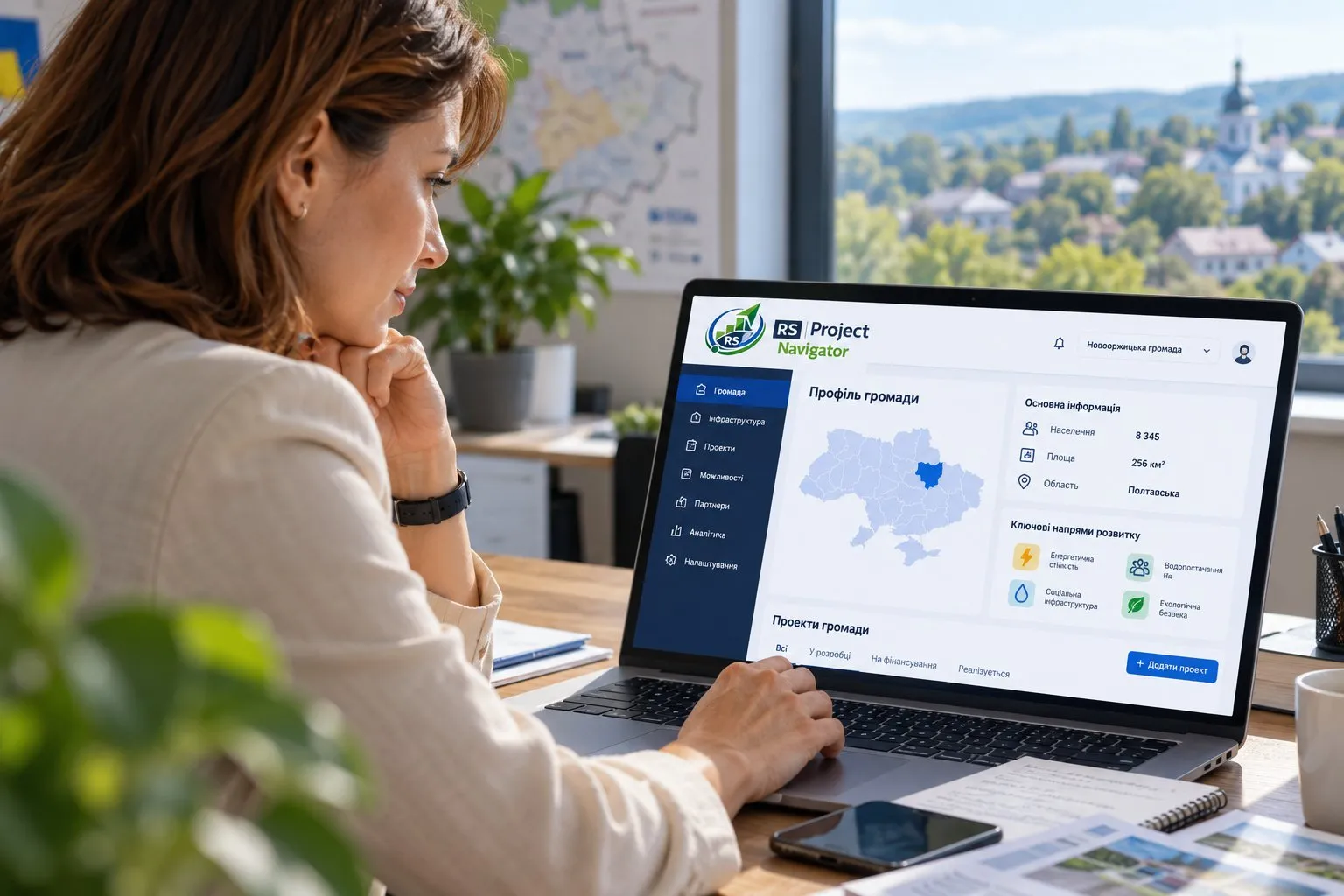
Behind every active territorial community (hromada) in Project Navigator is an individual. They work with data and projects, seek new opportunities, maintain contacts and help make their community visible beyond its boundaries. The platform’s first six months of active operation have already revealed coordinators who are gradually becoming local development leaders.
What determines a small community’s prospects today?
Its budget? Population? The presence of large enterprises? All of these certainly matter.
Yet another resource is becoming increasingly important — people who can find opportunities for their community and turn them into specific projects.
We increasingly see just such people among Project Navigator coordinators.
What is Project Navigator?
It is a digital ecosystem for Ukrainian communities that helps turn community needs, data, strategic and planning documents, and expert assessments into specific project ideas and gradually prepare them for potential funding.
The platform’s logic is quite simple: first understand the community’s need, substantiate it with data, develop a solution, assess it and prepare a project, before starting to look for a grant.
In a single digital environment, a community can work with data, documents and projects, view their status and see the next steps. The platform’s development also provides for interaction with Regional (Oblast) Military Administrations, experts, businesses, partners and donors. The most developed project ideas may enter a project pipeline for further work with potential partners. Explore Project Navigator → pronavigator.eu
Project Navigator already brings together around 120 territorial communities in Ukraine.
But a digital platform changes nothing on its own.
Data do not update themselves. A project idea does not turn itself into a prepared project. And a community does not become visible to potential partners simply because it has been given a digital dashboard.
That requires a person.
This is why the coordinator plays a special role in every community working with Project Navigator.
A coordinator is already more than a platform administrator
At first, the coordinator’s role may have seemed mainly technical: registering the community, working with the dashboard, updating information and maintaining contact with the Project Navigator team.
The experience of recent months reveals much more.
A strong coordinator gradually becomes one of the community’s own resources.
This is particularly important for a small community.
A large city may have an economic department, an international cooperation office, an investment office and several project management specialists.
In a small community, much of this work often rests on one or a few active people.
They know where to find the necessary data. They remember which projects have already been discussed. They can quickly prepare information for a partner, join a working meeting, take a training course or present a community need.
And having such a person already gives the community a competitive advantage.
The community should see its coordinator as an opportunity
We would like this to be understood by the coordinators themselves and, above all, by community leaders and residents.
When a coordinator attends professional events, training and working groups, communicates with Ukrainian and international partners, works on projects and represents the community beyond its boundaries, this is not a secondary activity “after their main job”.
It is work for the community’s development.
One professional contact may eventually grow into a partnership. A clearly presented community problem may become the basis of a future project. And a prepared project may have a chance of funding when a suitable programme opens.
Of course, a coordinator cannot guarantee a grant or investment for the community.
But they can do something without which a funding opportunity often never arises: help the community be prepared, understandable and visible.
A community’s visibility has real value today
An international partner or donor cannot possibly know hundreds of Ukrainian communities equally well.
Communities therefore have to compete for more than money.
First, they compete for attention.
Can the community quickly explain which problems it is addressing? Which projects it is preparing? Why these are priorities? What data support them? What has already been done? What is the next step? And, finally, who can continue this conversation?
Clear answers to these questions make a community much easier to see.
This is why a coordinator’s presence at Ukrainian and international events, in training programmes, professional networks and meetings with partners also promotes the community itself.
And such people deserve support.
The most active Project Navigator coordinators during the platform’s first six months of active operation
During approximately the first six months of the platform’s active operation, a group of coordinators who work consistently with Project Navigator has already emerged.
They include:
-
Hanna Lysenko — Novoorzhytske community, Poltava Oblast;
-
Yuliia Nesen — Dmytrivka community, Kyiv Oblast;
-
Marta Ilkiv — Boryslav community, Lviv Oblast;
-
Yevheniia Stoliarchuk — Liuboml community, Volyn Oblast;
-
Hennadii Polukhin — Kobleve community, Mykolaiv Oblast;
-
Maryna Diduk — Shepetivka community, Khmelnytskyi Oblast;
-
Nataliia Kuzma — Kamianske community, Zakarpattia Oblast;
-
Mariia Romaniuk — Rozdilna community, Odesa Oblast;
-
Dora Tsymbalar — Novoborysivka community, Odesa Oblast;
-
Iryna Pukalova — Katlabuh community, Odesa Oblast.
We deliberately do not want to turn this list into a sporting league table.
Activity in a digital system is only one indicator. Far more important is that these people demonstrate a willingness to work systematically on their community’s development and go beyond routine administrative tasks.
These people need to be recognised
This message is addressed primarily to community leaders.
If your community has someone who seeks new opportunities, works on projects, represents the community externally, maintains contacts with partners and is willing to keep learning, do not take this for granted.
Such a coordinator needs access to information from different departments. They should be involved in discussions of strategic and investment decisions. They need opportunities to participate in professional events and represent the community where new contacts and partnerships may emerge.
Residents themselves should also know these people.
A local development leader is not necessarily a top-ranking official.
Sometimes it is someone who one day began systematically gathering their community’s projects, seeking opportunities and talking about it in places where it was previously unknown.
From a network of coordinators to a community of development practitioners
We want the Project Navigator coordinator network to gradually become a community of development practitioners, rather than simply a network of digital platform users.
We want coordinators from different oblasts to know one another, exchange experience, see other communities’ solutions, participate in joint working meetings and represent their communities more widely across Ukraine and internationally.
Project Navigator will then fulfil another function that may have been less obvious at the outset.
It will connect data, documents, needs and projects.
It will also connect the people capable of moving these projects forward.
And perhaps one increasingly common indicator of a community’s prospects will be a very simple question: