
More and more territorial communities (hromadas) in Ukraine are beginning to prepare Local Waste Management Plans (LWMPs). For some, this means meeting legal requirements; for others, it is an opportunity to review their entire waste management system; and for others still, it is a first step towards future investment.
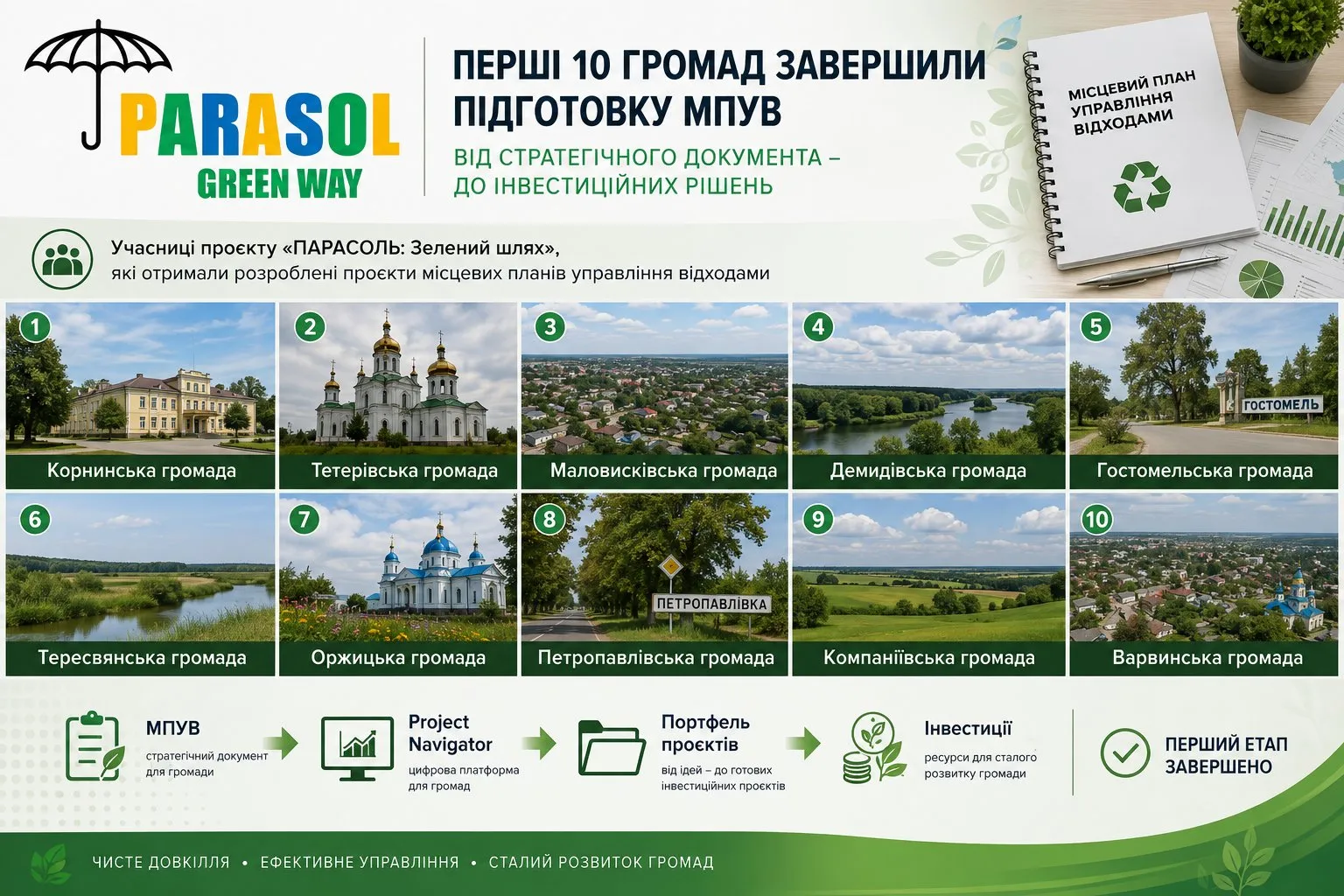
For Kornyn, Teterivka, Mala Vyska, Demydivka, Hostomel, Teresva, Orzhytsia, Petropavlivka, Kompaniivka and Varva communities, this marks the beginning of a new stage rather than the end of the work.
The first ten participating communities have received draft Local Waste Management Plans. Yet the main outcome of this work went beyond the documents themselves. It revealed common problems that almost all Ukrainian communities face today when preparing LWMPs.
Experience shows, however, that having a document does not yet mean a community has an effective development tool.
While working with the first communities under the PARASOL: Green Path initiative, experts observed an interesting pattern. Most difficulties arise well before a document has been written, during information collection, situation analysis and the identification of real priorities.
That is why the quality of an LWMP is determined by whether it helps community leaders make management decisions, rather than by its page count.
What practical experience has shown: drafting begins before the data are understood
All Ukrainian communities must prepare their own LWMP. Today, 104 communities are already working in Project Navigator, and 45 of them are preparing Local Waste Management Plans. This practical experience reveals common problems that recur regardless of a community’s oblast or size, rather than isolated cases. How much waste is generated?
What proportion of the population actually receives the service?
What is the condition of the waste container stock?
How are collection routes organised?
How much does the system actually cost?
Without answers, any plan risks becoming a set of assumptions.
The document is written to meet a requirement
Sometimes an LWMP is seen as yet another mandatory document to be approved and filed away.
This approach almost never leads to change.
The central issue is to go beyond describing a problem to understand its causes, assess risks and find management solutions. That is when a plan begins to work.
Goals exist, but there is no mechanism for achieving them
Almost all communities want to build a modern waste management system.
Yet concrete requirements always stand between intentions and results: funding sources, implementation timeframes, responsible implementers and the prioritisation of measures.
Without these, even a sound strategy remains a declaration.
The plan exists separately from the territory
A waste management system involves more than figures.
It includes roads, logistics, land plots, starosta districts, sanitary restrictions and existing infrastructure.
Sometimes these apparent “minor details” determine whether a project will work once implemented.
Costly inaccuracies
Outdated terminology, inconsistent indicators and procedural errors during Strategic Environmental Assessment or public consultations may seem like technical details.
There have been cases where different community documents contained different population figures or waste generation data. From the outset, this complicated further calculations and required information to be checked again.
In fact, these are often the very things that cause problems after a document has been approved.
What a community should do today
Experience shows that a good LWMP does not begin with writing the text.
It begins with collecting data, open dialogue with municipal enterprises and starosta districts, analysing the community’s financial capacity and continually checking the document’s internal logic. This approach turns a plan into a real management tool rather than a formality.
A document that must work
Today, legal requirements effectively oblige every community to develop a Local Waste Management Plan.
Yet the true value of this document will be determined by more than its approval date.
It will be determined by whether it helps the community make decisions, plan infrastructure development, develop investment projects and attract funding.
This is where the next stage begins.
In our next article, we will explain how to turn a good LWMP into an investment portfolio and why a modern strategic document must work for potential investors as well as regulatory authorities.
Communities have now learned to prepare strategic documents. The next challenge is to make those documents work. This will determine whether an LWMP becomes another mandatory document or the first step towards a modern management system and attracting investment.