Ukrainian territorial communities (hromadas) face a new deadline that is difficult to ignore.
Once a regional waste management plan enters into force, communities have one year to develop and approve their own Local Waste Management Plan (LWMP).
Formally, this is a legal requirement.
In practice, it is a new filter for access to funding.
Without an LWMP, a community could very soon find itself excluded from all environmental programmes, whether donor-funded or investment-based.
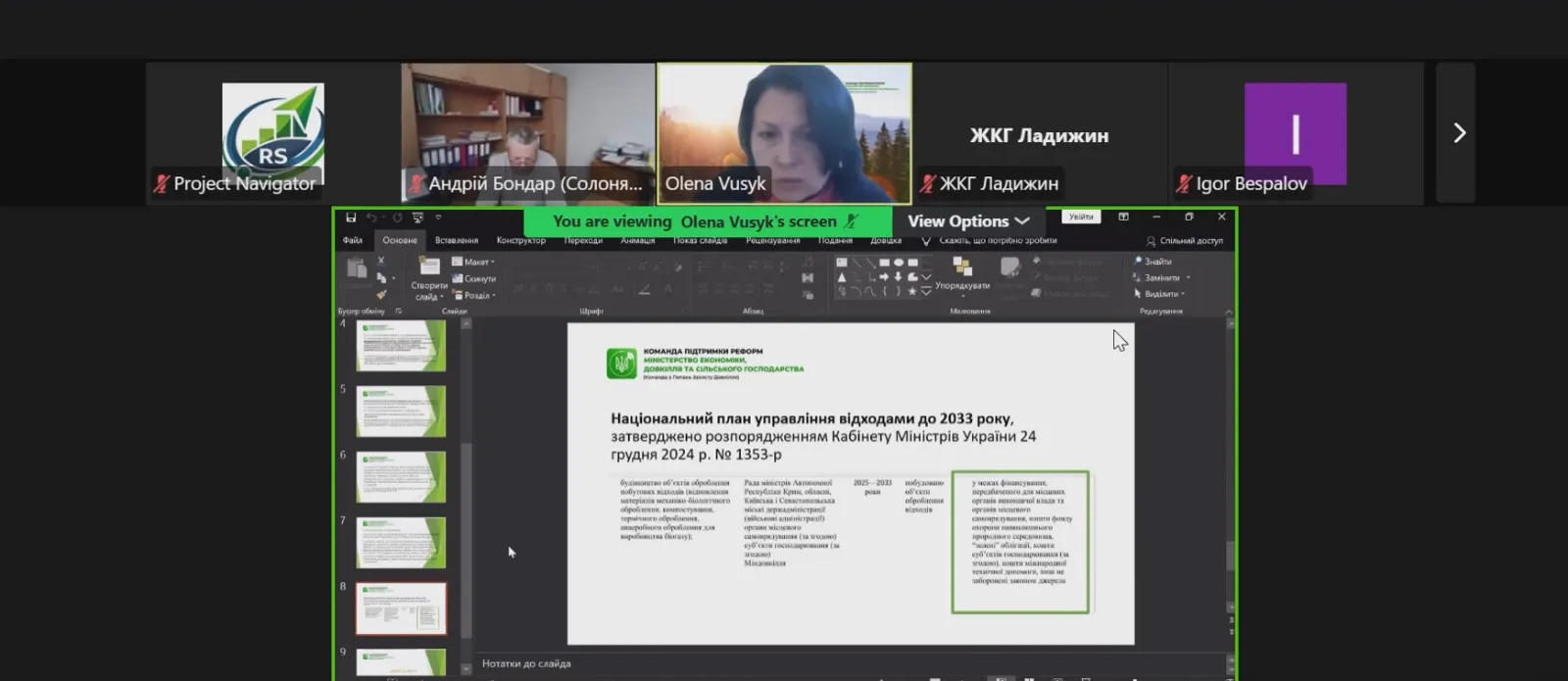
This was the focus of a recent webinar that brought together community representatives, experts and waste management practitioners. The event’s speaker, Olena Vusyk, Senior Project Manager for Waste Management Reform in the Ministry of Economy’s Reform Support Team, emphasised the limited time available. As of 17 March 2026, the Ministry of Economy had already endorsed 13 Regional Waste Management Plans (RWMPs).
Recent experience shows that simply having a strategic document no longer guarantees anything. Communities may spend months preparing plans, convening working groups and agreeing on wording, only to end up with a document that neither banks nor donors read.
The reason is simple:
most such plans are text. Investors need more than text. They need:
• figures, volumes, models and clear project economics.
This is why a gap is emerging today: the documents exist, but the investment does not.
The law has started the “timer”
Under the law, once a regional plan has been approved and entered into force, a community has one calendar year to develop and adopt its LWMP. The document must also undergo a Strategic Environmental Assessment (SEA) and be publicly accessible. As of March 2026, most regions are already involved in this process. This means that for many communities, the countdown has begun.
The question is no longer whether an LWMP is needed.
The question is what it will look like.
In professional discussions and consultations with communities, the same problem is raised increasingly often: a lack of high-quality, relevant data.
For a plan to work, a community needs to understand:
• how much waste it actually generates, what types of waste, where it is generated and what happens to it next.
This now goes beyond household waste.
A modern LWMP must include planning for biowaste, destruction waste, industrial and agricultural waste, medical and hazardous waste, waste tyres, batteries, lubricants and oils, and sewage sludge. Without this picture, any plan remains a formality.
From plans to money: where the system breaks down
Even if a community gets through this difficult stage and creates a good document, the next barrier arises. How can it turn the plan into funding?
Building sorting lines, landfills or recycling facilities is a matter of investment rather than strategy. And here the problem appears again:
there is no “translator” between the document and the money. Plans are written in the language of administration.
Investors work in the language of finance.
A digital “translator” for communities
New tools emerging alongside the reform are seeking to close this gap. One approach is to digitise strategic documents through the Project Navigator platform, which is being developed by RCERBS Fund engineers with support from the international organisation Bankwatch Network. Its logic is simple but fundamentally different: instead of static text, a community receives a working system.
LWMP data are structured, checked, digitised and then automatically transformed into investment profiles that international partners can understand.
In practice, a key change takes place: a document “for reporting purposes” becomes a tool for attracting funding.
The community ceases to be a “point on the map” and becomes an entity with specific parameters:
cost, impact and potential.
New rules of the game
Today, an LWMP goes beyond compliance. It concerns a community’s position in the new recovery economy. Those who work with data and develop investment solutions gain access to resources. Those who delay or limit themselves to a formal approach risk being left out of the process.
The main conclusion is simple
The legislative “timer” has already started. The decisive factor, however, is the ability to turn the document into a development tool rather than the speed at which it is written. In the coming years, having a high-quality, costed and “translated” LWMP will become a gateway to funding for communities.
The question now sounds different:
rather than “will there be a plan”,
it is “will it turn into funding”.
Photos