
Net Zero SMEs: how eight European regions — including Ukraine — are helping small businesses go climate-neutral
5/10/20263 min read
Small and medium-sized enterprises generate over half of the EU's GDP — and at the same time over 63% of corporate CO₂ emissions. The eight-region Net Zero SMEs project is looking for what actually works. Ukraine is among the partners.
Why small business is the key to Europe's green transition
Small and medium-sized enterprises (SMEs) generate more than 50% of the EU's GDP. At the same time, they are responsible for over 63% of CO₂ and other greenhouse gas emissions from the EU's entire enterprise sector. The figures come from a 2025 report by the Platform on Sustainable Finance prepared for the European Commission.
The report puts it plainly: "the transition to a net-zero, resilient and environmentally sustainable economy will not be achieved without the transition of SMEs."
Yet SMEs that try to go net-zero keep running into the same barriers — limited access to funding and the difficulty of building partnerships with research institutions.
Eight regions joined forces — Ukraine is one of them
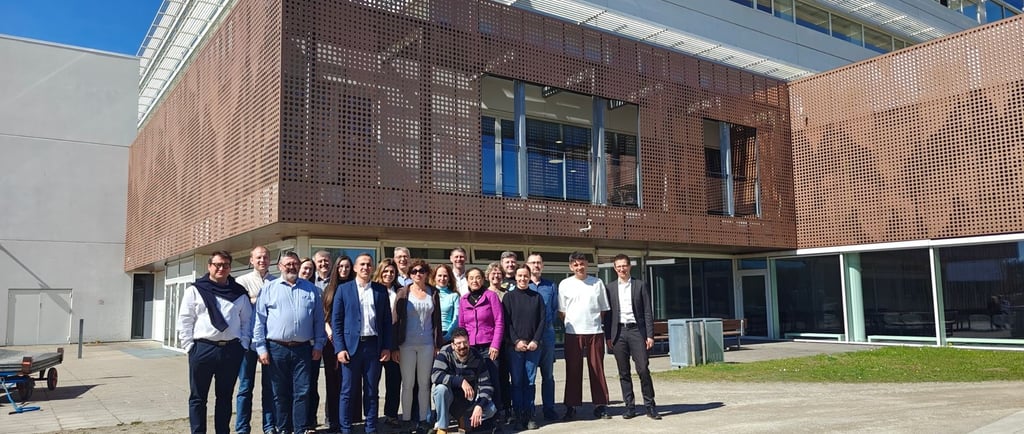
To tackle these barriers, eight European regions have launched the Net Zero SMEs project: Sweden, Belgium, Hungary, Bulgaria, Ukraine, Denmark, and two regions of Greece.
The objective is to strengthen policies that enhance the production capacity of net-zero SMEs.
The project is led by the Region of Epirus in Greece. In the words of Kalliopi Tesia, who represents the regional administration:
«The future of the European path must go through the development of greener technologies and clean energy solutions — not only in terms of environmental protection, but also in terms of boosting the European economy and growth.»
Epirus's economy is built on agriculture and tourism — picturesque villages scattered across mountainous terrain that have seen steadily rising visitor numbers in recent years. The region acknowledges that green and digital solutions are still poorly integrated into its traditional sectors. One of the project's tracks is to connect local SMEs with researchers at the University of Ioannina, since businesses often fail to absorb existing academic work.
Three practices worth replicating
The project launched in 2025 and has already identified three concrete good practices that can be transferred to other partner regions.
Hungary — a national programme for energy innovation
Hungary has introduced a national funding programme for research and development in energy. It is open both to SMEs and to large companies, and applicants can submit joint proposals together with universities and research institutes. The programme supports three focus areas:
hydrogen technologies;
renewable gases;
energy efficiency in buildings.
Bulgaria — an online self-assessment tool for SMEs
Bulgarian partners have developed the ARIES4 Self-Assessment Tool through the Erasmus+ programme. It is a free online service that helps small businesses:
assess their own sustainability;
identify strengths and gaps;
monitor progress over time on their journey to net-zero.
Sweden — a year-long learning programme for construction
In the city of Helsingborg, the initiative CoBuild Change Makers runs as part of the broader EU-funded CoBuild NetZero project. It is a year-long learning programme for people who lead or participate in climate-related projects in construction and civil engineering — a sector that is traditionally one of the heaviest emitters.
Why this matters for Ukrainian communities
Ukraine takes part in Net Zero SMEs as a full partner region. That means access to European expertise, but it also means an opportunity to present Ukraine's own work — municipal energy plans, waste management plans, and climate adaptation strategies developed by local communities.
Each of the three good practices resonates with the Ukrainian agenda:
The Hungarian model of funding energy R&D — a reference point for Ukraine's national and local energy-efficiency programmes, which should embed cooperation with universities and industry.
The Bulgarian self-assessment tool is highly transferable to Ukrainian SMEs, where the demand for simple, free sustainability assessment tools is acute.
The Swedish year-long training model for construction is particularly relevant given Ukraine's reconstruction agenda — construction is where Net Zero standards will be locked in for decades to come.
What's next
Net Zero SMEs is still in its early stages. The team aims to find "more efficient policies and tools for our regional funds", and to expand the catalogue of practices the partner regions can learn from each other.